Body Piercing Jewelry Materials: What's Safe and What's Not
That $5 nose ring from the mall might look cute in the package, but what's it made of? Here's everything you need to know about piercing jewelry materials — what's safe, what's not, and why it matters.
The jewelry you wear in a piercing isn't a fashion accessory. It's a medical device in direct contact with your tissue 24 hours a day, often while that tissue is actively healing. The difference between implant-grade titanium and a cheap plated ring isn't just aesthetics — it's the difference between a clean heal and months of inflammation, rash, and rejection. At Platinum Body Piercings, we use implant-grade titanium and solid gold exclusively for initial piercings. This guide explains what that means and why it matters.Body Piercing Jewelry Materials: What's Safe and What's Not
The Safe Materials
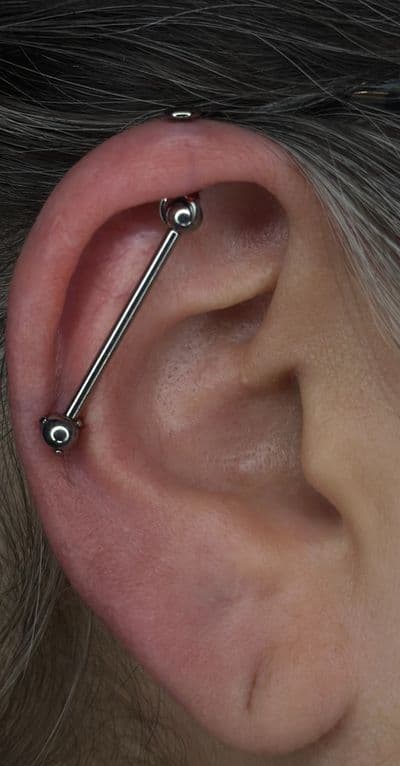
Implant-Grade Titanium (ASTM F136)
This is the gold standard for initial piercings, and what we reach for first.
What it is: Titanium alloy (Ti-6Al-4V ELI) meeting ASTM F136 specification — the same standard used for orthopedic implants, bone screws, and surgical instruments inside the human body.
Why it's ideal:
- Contains no nickel — the most common cause of metal allergic reactions
- Exceptionally biocompatible — your body does not react to it
- Lightweight — even large pieces of titanium feel like nothing
- Available anodized — titanium can be colored through an electrical process (anodizing) without adding coatings or chemicals. The color is part of the metal's surface oxide layer.
- Long track record in human tissue — decades of implant data confirms safety
What to look for: "Implant-grade titanium," "ASTM F136," or "Ti-6Al-4V ELI." If a seller just says "titanium," that's not specific enough.
Solid Gold (14k or 18k)
Solid gold is excellent for initial and healed piercings — with the right karat and alloy.
14k gold: 58.3% gold, with the remainder typically nickel-free alloys like silver, copper, or palladium when specified as "nickel-free 14k." Durable enough for daily wear.
18k gold: 75% gold. Slightly softer than 14k but higher purity. Either karat works well in piercings.
What to avoid:
- Gold-plated: a layer of gold over base metal. The layer wears away, base metal contacts tissue.
- Gold-filled: thicker layer than plated but same problem over time.
- Gold vermeil: same issue.
- Unknown alloy yellow metal: "looks like gold" is not a metal specification.
Tip: White gold often contains nickel. If you're nickel-sensitive, stick to yellow gold or specify nickel-free white gold alloy.
Implant-Grade Niobium
Pure niobium is a hypoallergenic, nickel-free metal that behaves similarly to titanium in body piercings. It can also be anodized for color. Slightly softer than titanium, which means jewelry typically maintains its shape well. An excellent option for people who want color without titanium.
The "It Depends" Materials
316L / 316LVM Surgical Steel
This is the material where most confusion lives, because "surgical steel" gets thrown around as a synonym for safe — and it isn't always.
The good: Implant-grade 316L and 316LVM surgical steel, when properly specified and finished, can work well for healed piercings in people without nickel sensitivity. It's dense, durable, and has been used in body piercings for decades.
The problem:
- 316L surgical steel contains 2–3% nickel — a common allergen. In most healed piercings with intact tissue this isn't an issue, but during healing, nickel can leach through damaged tissue and cause reactions.
- Most "surgical steel" sold by online retailers and mall kiosks is not implant-grade 316L. It's an unspecified steel grade with unknown nickel content, polished to look like surgical steel.
- There is no standard definition of "surgical steel" in the jewelry industry. Manufacturers can call anything surgical steel.
Our recommendation: Avoid surgical steel for initial piercings. For healed piercings on people without nickel sensitivities, verified implant-grade 316L is acceptable. When in doubt, use titanium.
Materials to Avoid Entirely
Acrylic / Plastic (Other Than PTFE)
Acrylic scratches easily, harboring bacteria. It's porous. It off-gases chemicals into your tissue. It's not appropriate for piercings at any stage. Exception: PTFE (polytetrafluoroethylene, or Teflon) is the one plastic that is considered biocompatible and is used for certain retainers and flexible jewelry — but it's the exception, not the rule.
Brass, Bronze, Copper
These metals oxidize and leach compounds (including copper and zinc) into tissue. They turn skin green. They cause reactions. Avoid entirely.
Sterling Silver
Surprising to many — silver is actually a problematic material for piercings. Sterling silver (92.5% silver) tarnishes, and tarnished silver deposits sulfur compounds into tissue, causing permanent gray discoloration called argyria. Fine for earrings you take out at night; terrible for piercings that stay in.
Plated, Coated, or Painted Metals
Any jewelry where the surface treatment is a layer over a different base metal is not appropriate for piercings. The coating wears away. What's underneath is usually not something your body wants to live with.
Mystery Metals
Jewelry with no disclosed composition, sold as "hypoallergenic" or "nickel-free" without certifiable specifications. "Hypoallergenic" has no legal definition in the jewelry industry. Demand specific material disclosures.
The ASTM Standards, Simply Explained
ASTM International is a standards organization that publishes technical specifications for materials. When a material is "ASTM F___," it means its composition, mechanical properties, and processing have been validated to meet specific requirements:
- ASTM F136: Implant-grade titanium (Ti-6Al-4V ELI). The specification for titanium used in the body.
- ASTM F138: Implant-grade 316LVM surgical steel. The specification for stainless steel used in implants.
- ASTM F67: Unalloyed (commercially pure) titanium. Also acceptable for piercings.
When we say "implant-grade," we mean these materials meet these documented standards — not just that someone stamped the word "implant-grade" on a product page.
What We Use at Platinum Body Piercings
We source jewelry exclusively from manufacturers who produce verified implant-grade titanium and solid gold pieces. We don't carry mystery metals, plated jewelry, or anything we wouldn't put in our own piercings. If you bring in outside jewelry you want us to pierce with, we'll assess the material before proceeding — it's part of how we protect your healing.

Questions about your current jewelry? Thinking about an upgrade? Come see us at Platinum Body Piercings, North Star area, San Antonio. We're happy to advise.
Frequently Asked Questions
What is the safest material for body piercings?
Implant-grade titanium (ASTM F136) is widely considered the safest option for initial piercings. It's hypoallergenic, nickel-free, lightweight, and accepted by virtually all body tissue. Solid 14k or 18k gold and implant-grade niobium are also excellent choices.
Is surgical steel safe for piercings?
It depends. High-quality surgical steel (implant-grade 316L or 316LVM) can work for healed piercings in people without nickel sensitivities. However, "surgical steel" sold by many retailers is an unspecified grade, may contain significant nickel, and should be avoided for initial piercings or sensitive individuals.
Is gold-plated jewelry safe for piercings?
No. Gold-plated or gold-filled jewelry has a base metal underneath the gold coating. Once the coating wears (and it always wears), you're left with the base metal — often brass or low-grade alloy — directly against your healing tissue. Use solid gold only.
What does ASTM F136 mean?
ASTM F136 is an American Society for Testing and Materials standard for implant-grade titanium alloy (Ti-6Al-4V ELI). It specifies exact elemental composition, mechanical properties, and cleanliness requirements. Jewelry stamped ASTM F136 has met rigorous standards for use in the human body.
Book Your Piercing
Walk-ins welcome for piercings. Book ahead to reserve your spot at Platinum Body Piercings.
📍 7400 San Pedro Ave, San Antonio, TX 78216