Industrial Piercings: The Bold Statement Piece
The industrial is one of the boldest ear piercings available — a single barbell connecting two separate cartilage points. Here's what makes it work, and what makes it challenging.
Industrial Piercings: The Bold Statement Piece
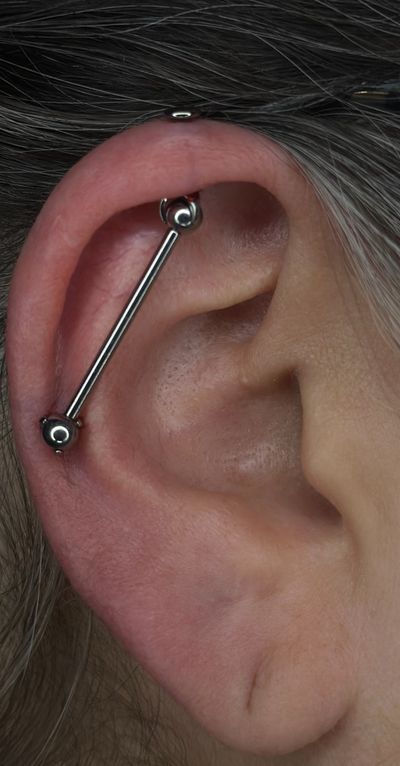
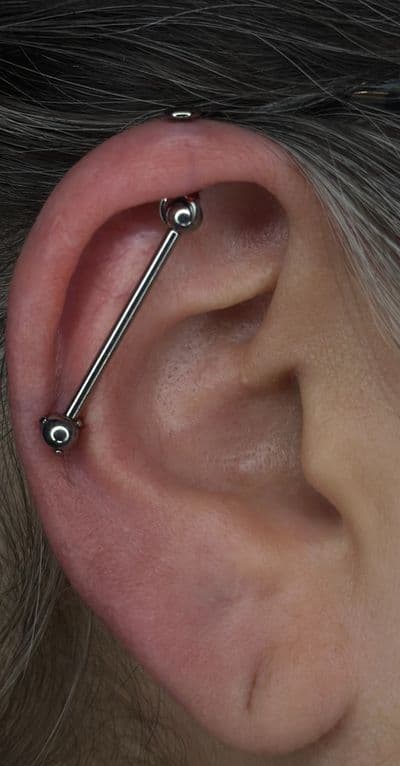
The industrial piercing is immediately recognizable — a single straight barbell crossing the upper ear, connecting two separate cartilage piercings in one dramatic piece. It's striking, architectural, and unmistakably intentional. It also requires more from both the client and the piercer than most ear piercings.
At Platinum Body Piercings near North Star Mall in San Antonio, Noah and the team take industrial piercings seriously. Here's what you need to know before committing.
The Anatomy Requirements
Not every ear can support an industrial piercing, and this is genuinely important to establish before booking. The standard industrial connects a helix piercing (outer upper cartilage) to an antihelix or forward helix piercing, with a straight barbell running between them at roughly a 45° angle.
For this to work well, you need:
- Sufficient flat, stable cartilage at both piercing points
- Adequate ridge structure to support the barbell ends without constant pressure
- Enough space between the two points for a properly sized barbell (if the ear is very small, the barbell sits too close to the surface at either end)
- Compatible angle — if the natural curvature of your ear creates a severe angle, the barbell can't sit straight without torquing the piercings
Ears that are very small, have flat cartilage ridges, or have pronounced curvature may not be suitable for a traditional industrial. This isn't a barrier to everything — there are vertical industrials, short industrials, and custom variations that work on different anatomies. But the classic version has real requirements. A consultation tells you definitively which options are on the table.
The Healing Challenge
Let's be direct: the industrial is one of the more demanding piercings to heal, and it's not a good first cartilage piercing for most people. Here's why:
You're healing two cartilage piercings simultaneously. Every piece of jewelry in your body can experience "sympathetic irritation" — where something affecting one end of the jewelry is felt at the other end. With an industrial, the barbell physically connects two piercings, so any force on one point is directly transmitted to the other. A pillow pressing on the helix end? The forward helix end feels it. Glasses resting on the barbell? Both piercings feel it.
This makes the industrial extremely sensitive to external pressure, and external pressure is difficult to avoid completely. Sleep position, headwear, phone use, hairstyles that touch the ear — all of these become factors you need to manage during the 9–18 month healing period.
That said, many people heal industrials beautifully. The key is understanding the commitment upfront and actually managing these factors rather than hoping they won't matter.
Jewelry Options for Industrial Piercings
Standard straight barbell. The classic and most common. A straight barbell with balls, spikes, or flat discs on each end. For initial piercings, the barbell needs to be slightly longer than the final jewelry to accommodate swelling — your piercer will fit this precisely.
Decorative barbells. Once healed, industrials can wear barbells with decorative elements along their length: gems set in the center, arrow motifs, geometric shapes, or chain drops that hang from the barbell. These elements are permanently attached to the barbell and provide significant visual interest across the upper ear.

Curved or angled variations. For non-standard anatomy or custom aesthetics, bent barbells can accommodate ears that don't work well with straight pieces. These require custom fitting but open up the industrial to anatomies that the straight version doesn't suit.
Connected ring industrials. Advanced setups where the two piercing points are connected by chain rather than a rigid bar, allowing more movement — some anatomy responds better to this flexibility during healing.
Aftercare Specifics for Industrials
Standard saline rinse aftercare applies, with some important additions:
Sleep setup. Use a travel pillow with a center hole to suspend your ear — this is practically mandatory for industrial healing. Even a few nights of pillow pressure early in healing can set back the process significantly.
Glasses and headphone users. Glasses frames that rest on or near the upper ear can create constant low-level pressure on the barbell. If you wear glasses, discuss this with Noah at your consultation — placement adjustment can sometimes mitigate this, or we can talk through strategies. Over-ear headphones are genuinely problematic for the entire healing period and we recommend in-ear alternatives during this time.
Hair management. Long hair can catch on the barbell ends. Wearing hair up or secured away from the ear, especially in the first several months, reduces snag risk significantly.
No rotating, no touching. The industrial tempts people to check it, adjust it, rotate it. Resist entirely. Movement disrupts both healing sites simultaneously.
Custom Industrial Variations
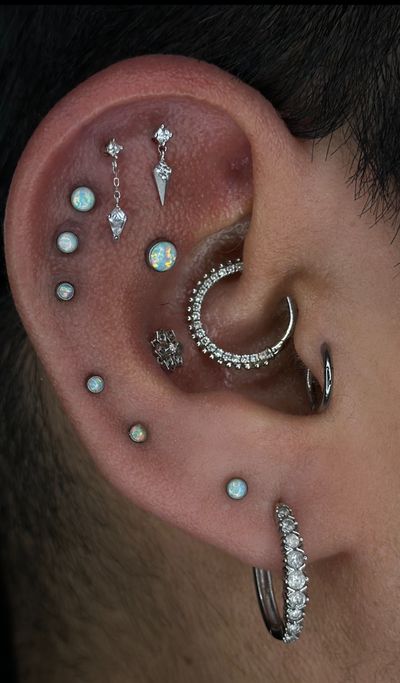
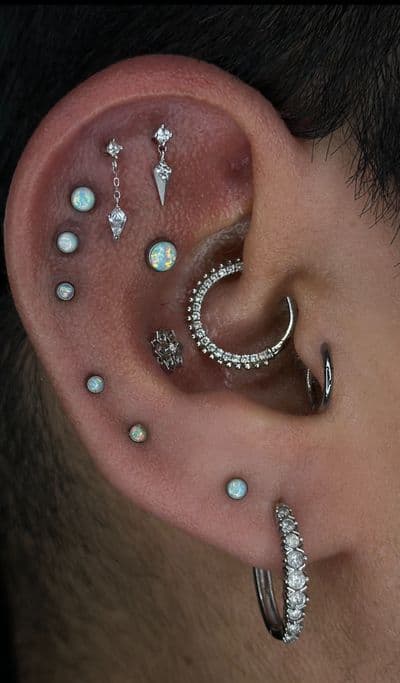
The industrial piercing has evolved beyond the single straight barbell. Artists and piercers have developed creative variations: the "orbital industrial" (connecting three points with chain elements), the "ear project industrial" (planned as part of a larger curated ear), vertical industrials, and short industrials that connect closer anatomical points for ears with limited real estate.
If you're interested in something beyond the standard setup, bring your ideas to a consultation. Noah is experienced with custom ear work and can help assess what's possible given your anatomy. Service fees start at $35. Find us near North Star Mall in San Antonio.
Frequently Asked Questions
Can everyone get an industrial piercing?
No — the industrial piercing requires sufficient cartilage anatomy: a flat, stable helix and an antihelix positioned correctly relative to each other. Ears with flat or absent upper ridges, very small ears, or pronounced cartilage curvature may not have the anatomy to support an industrial safely. A consultation with Noah will tell you definitively whether your anatomy works.
Why does my industrial piercing keep getting irritated?
The most common causes: sleeping on it (pressure on one end affects both), wearing glasses or headphones (same issue), a barbell that's too short or too long for your anatomy, or changing jewelry too early. Industrial piercings are very sensitive to external force — even mild, repeated pressure from a pillow is enough to cause irritation bumps.
How long does an industrial piercing take to heal?
Industrial piercings are among the longest-healing ear piercings — typically 9–18 months, and some take up to 2 years for full healing. You're healing two cartilage piercings simultaneously with a connecting barbell, and any movement in one affects the other. Patience is genuinely required here.
What jewelry styles work for a healed industrial?
The classic straight barbell is standard, but healed industrials can wear many variations: barbells with decorative center elements (gems, charms, arrows, chains), curved industrials, or connected rings. Custom industrial pieces can incorporate multiple decorative elements along the length of the barbell.
Book Your Piercing
Walk-ins welcome for piercings. Book ahead to reserve your spot at Platinum Body Piercings.
📍 7400 San Pedro Ave, San Antonio, TX 78216